Schroeder Family Ties to Bly, Oregon
The Schroeder family holds a meaningful place in Bly's community history, even though their roots extend beyond Klamath County. Warren F. Schroeder never lived in Bly, but his legacy reached the area through his family. His son later moved to Klamath County with his wife, Pat Schroeder, who became a teacher and played an impactful role for many local students. Their son, Kris Schroeder, married Bly native Marty (Harris) Schroeder. Kris and Marty attended fire school together in Gerber in 1997 and served on the first Bly Crew 1. Kris was hired as an assistant on a fire engine in Bly, where he worked for about five years. He later transferred to Klamath, where he became a fire engine captain. He then served as Assistant Fire Management Officer for the Goosenest area in McDowell, California, and later as Fire Management Officer in Tulelake. As of the latest update, he has transitioned from the Forest Service to the National Park Service. Marty's efforts in preserving and sharing the historical documents related to the family's firefighting legacy have made this story of service and innovation available to the community.
Kris's brother, Scott, also built his firefighting path in Bly. He attended fire school in 2002 at the Bly outer compound, worked on Bly Crew 1, and was hired in Bly as a Type 3 engine crew member. He currently serves on an integrated resource crew, with duties that include lookout operations and fire line support.
This family history provides local context for the story of Kris's grandfather, Major Warren F. Schroeder, and the origins of early aerial wildfire suppression research.
At a Glance Timeline
- 1953: Camp Pendleton wildfire sparks Schroeder's aerial foam idea.
- 1954: First Skyraider foam drops succeed at MCAS El Toro.
- 1955: M1 Fire Tank test releases 360 gallons over a wide footprint.
- 1956-57: Schroeder seeks Forest Service adoption of the concept.
- 1991: California Department of Forestry and Fire Protection issues a Certificate of Appreciation.
An Idea Born from Wildfire (Camp Pendleton, 1953)
On October 5, 1953, at Camp Pendleton, California, Major Warren F. Schroeder, a U.S. Marine Corps Reserve pilot, witnessed a forest fire burning east of the base. Wildfires in Southern California were devastating at the time, and the sight sparked a visionary idea: could aircraft fight forest fires from the air?
The Forest Service and military had experimented with water drops since the 1920s, but the approach was unproven. A 1940s study even discouraged water bombing, arguing that water would not reach the ground effectively. Undeterred, Schroeder sought a practical way to adapt wartime tools to firefighting.
His first thought was to repurpose surplus napalm tanks by filling them with water, but the idea was discouraged as too heavy and unsafe. Instead, he focused on foam, which could cling to vegetation and smother flames. With support from his commanding officer, Lt. Col. Frank P. Baker of Marine Attack Squadron 10, Schroeder developed a non-jettisonable belly tank that could open in flight and dispense a mixture of water and chemical foam.
Testing the First Aerial Foam Bomber (1954)
By early 1954, Schroeder had outfitted a Douglas AD Skyraider attack plane with an experimental foam tank. He modified a 250-gallon napalm tank with glass end-plates wired to explosive charges that could be triggered by the pilot. During a test flight at Marine Corps Air Station El Toro, the glass blew out, releasing a foam solution.
The result was encouraging: the Skyraider laid down a visible swath of foam roughly 50 feet wide and 300 feet long. Multiple test drops followed on January 15, January 29, and March 5, 1954, each leading to improvements in the release rate and foam mix. Despite minor setbacks, these trials demonstrated that an aircraft could deliver fire suppressant to the ground, a breakthrough for the era.
Developing the M1 Fire Tank (1955)
Encouraged by the 1954 tests, Schroeder refined the system for a faster, more reliable dump rate. Working out of the Naval Air Station at Corpus Christi, Texas, he built an improved tank from salvaged materials using the squadron's metal shop. By April 1955 the "M1 Fire Tank" was ready for a new trial.
On April 28, 1955, Lt. Col. Richardson piloted the Skyraider for the test. The new tank carried roughly 360 gallons of foam and blanketed an area about 40 yards by 200 yards. The test proved the concept at a larger scale, while also revealing the need for improved venting to fully empty the tank.
- 1953: Schroeder witnesses wildfire at Camp Pendleton and develops his foam-drop concept.
- 1954: First foam drop tests at MCAS El Toro demonstrate successful aerial suppression.
- 1955: M1 Fire Tank trial delivers 360 gallons over a wide footprint.
Reaching Out for Support
After proving the concept, Schroeder sought institutional backing. By 1956-57 he was corresponding with the U.S. Forest Service, sharing test reports and offering his expertise. Forest Service leadership acknowledged his work and encouraged him, but indicated that foam testing would be postponed while other retardant methods were studied.
Schroeder was eager to join the Forest Service air program and offered to relocate, even considering selling his Michigan landscaping business. Agency leadership urged caution, explaining that hiring would follow civil service processes and could not be guaranteed.
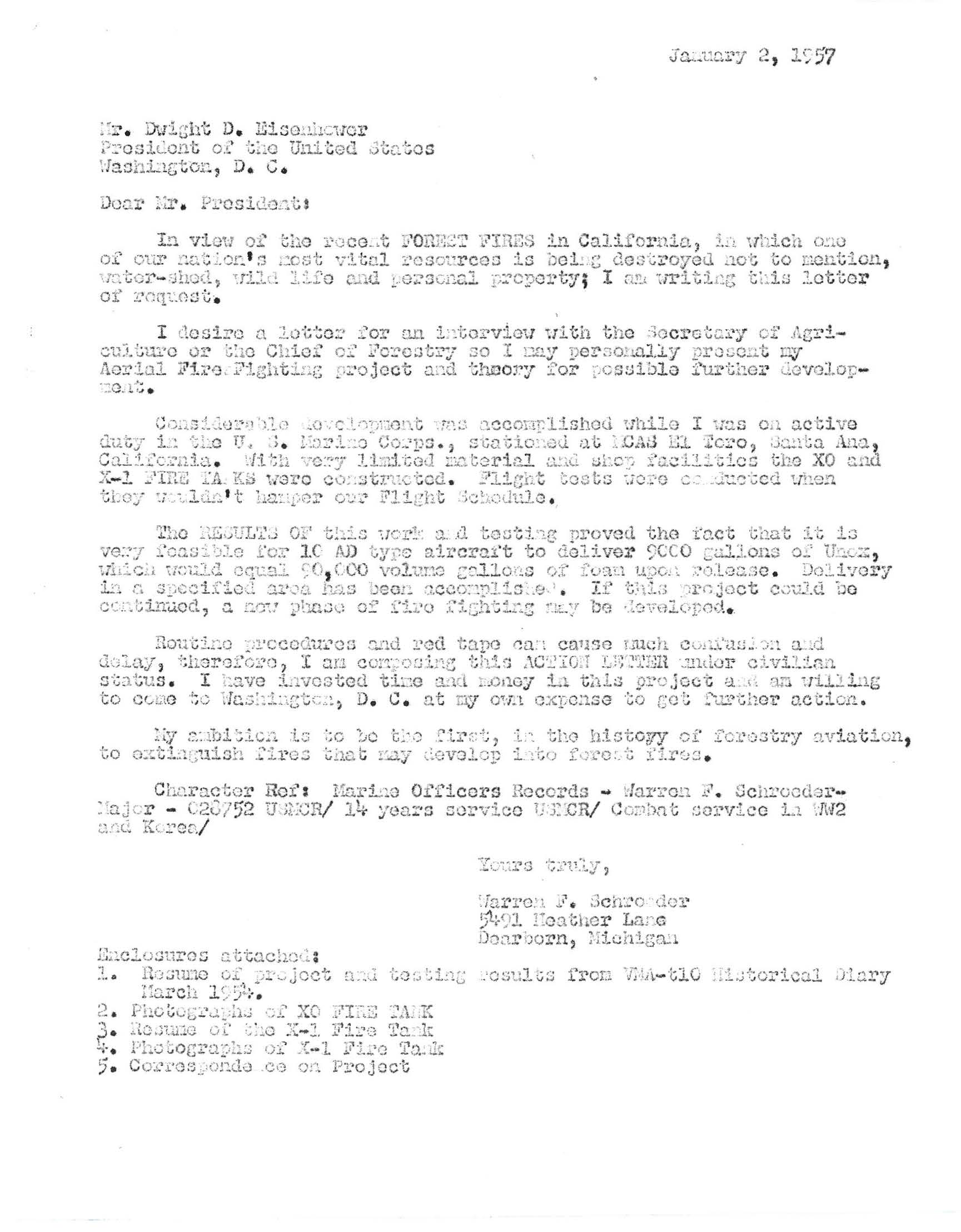
During this time, Schroeder also wrote to President Dwight D. Eisenhower, urging federal attention to wildfire threats and the promise of aerial suppression. The correspondence highlights his determination to apply military innovation for public protection.
A Legacy Ahead of Its Time
Schroeder did not become a Forest Service pilot, and the agency moved forward with other tanker programs using water and chemical retardants. Foam as a wildfire suppressant would re-emerge decades later, but his 1954-55 work foreshadowed the modern aerial firefighting era.
Historians credit his tests as a significant milestone in aerial fire control. His foam line, 50 feet wide and 300 feet long, demonstrated that aircraft could place suppressant on target, at a time when experts still doubted its effectiveness.
Remembering Warren Schroeder's Story in Bly's History
Bly, Oregon may be far from the Marine bases of California, but the connection remains meaningful. The Schroeder family legacy, from Pat Schroeder's teaching to Kris Schroeder's fire leadership, ties Warren's story to this community. Marty Schroeder preserved Warren's documents and photographs, ensuring this chapter of firefighting history is not lost.
Today, when air tankers fly over Klamath County, their work echoes the experiments Major Warren F. Schroeder pioneered. His story reflects innovation, service, and a lifelong commitment to protecting others.
Primary Source Document
Read the original family archive compiled by Marty Schroeder, including the test reports, correspondence, and documentation behind this story.
Document Gallery
Sources
- Primary Source (Direct family document): Warren F. Schroeder Papers (1954-1957). Unpublished family archive compiled and preserved by Marty Schroeder. Contains experimental reports, aircraft test documentation, photographs, and correspondence with the U.S. Forest Service regarding early aerial fire suppression concepts. This is the foundational primary source for Warren Schroeder's story. (No public link - private family document)
- Government & Institutional Sources (Context & History): U.S. Forest Service — Fire Management Today. Historical articles on the development of aerial firefighting practices in the U.S., including early experimentation with aircraft drops. fs.usda.gov/fire/management/today/
- Government & Institutional Sources (Context & History): U.S. Forest Service — Aviation History. Overview of Forest Service aviation, early tanker programs, and the evolution of aerial wildfire suppression research. fs.usda.gov/managing-land/fire/aviation
- Government & Institutional Sources (Context & History): U.S. Forest Service — Aerial Fire Control. Historical summary of the evolution of aerial fire control techniques. fs.usda.gov/fire/aviation/history
- Aviation & Military History Sources (Context): Smithsonian National Air and Space Museum — Skyraider Aircraft. Detailed history and specifications for the Douglas AD / A-1 Skyraider, the aircraft involved in early aerial firefighting experiments. airandspace.si.edu/collection-objects/douglas-a-1-skyraider
- Aviation & Military History Sources (Context): Air & Space Forces Magazine. Historical articles about post-World War II military aircraft and their adaptation to civilian and experimental roles, including wildfire application research. airandspaceforces.com
- Aviation & Military History Sources (Context): U.S. Naval History and Heritage Command. Official historical resource for U.S. Navy and Marine Corps aviation history, useful for context about the military background of aircraft and pilots like Warren Schroeder. history.navy.mil